
Editor's Pick: AI exposure and clinicians deskilling in colonoscopy
Endoscopist deskilling risk after exposure to artificial intelligence in colonoscopy: a multicentre, observational study
Krzysztof Budzyń, Marcin Romańczyk, Diana Kitala, Paweł Kołodziej, Marek Bugajski, Hans O Adami, Johannes Blom, Marek Buszkiewicz, Natalie Halvorsen, Cesare Hassan, Tomasz Romańczyk, Øyvind Holme, Krzysztof Jarus, Shona Fielding, Melina Kunar, Maria Pellise, Nastazja Pilonis, Michał Filip Kamiński, Mette Kalager, Michael Bretthauer, and Yuichi Mori
Lancet Gastroenterology & Hepatology
August 12, 2025
__
Q&A Video Featuring Shazia Siddique, MD, MSHP
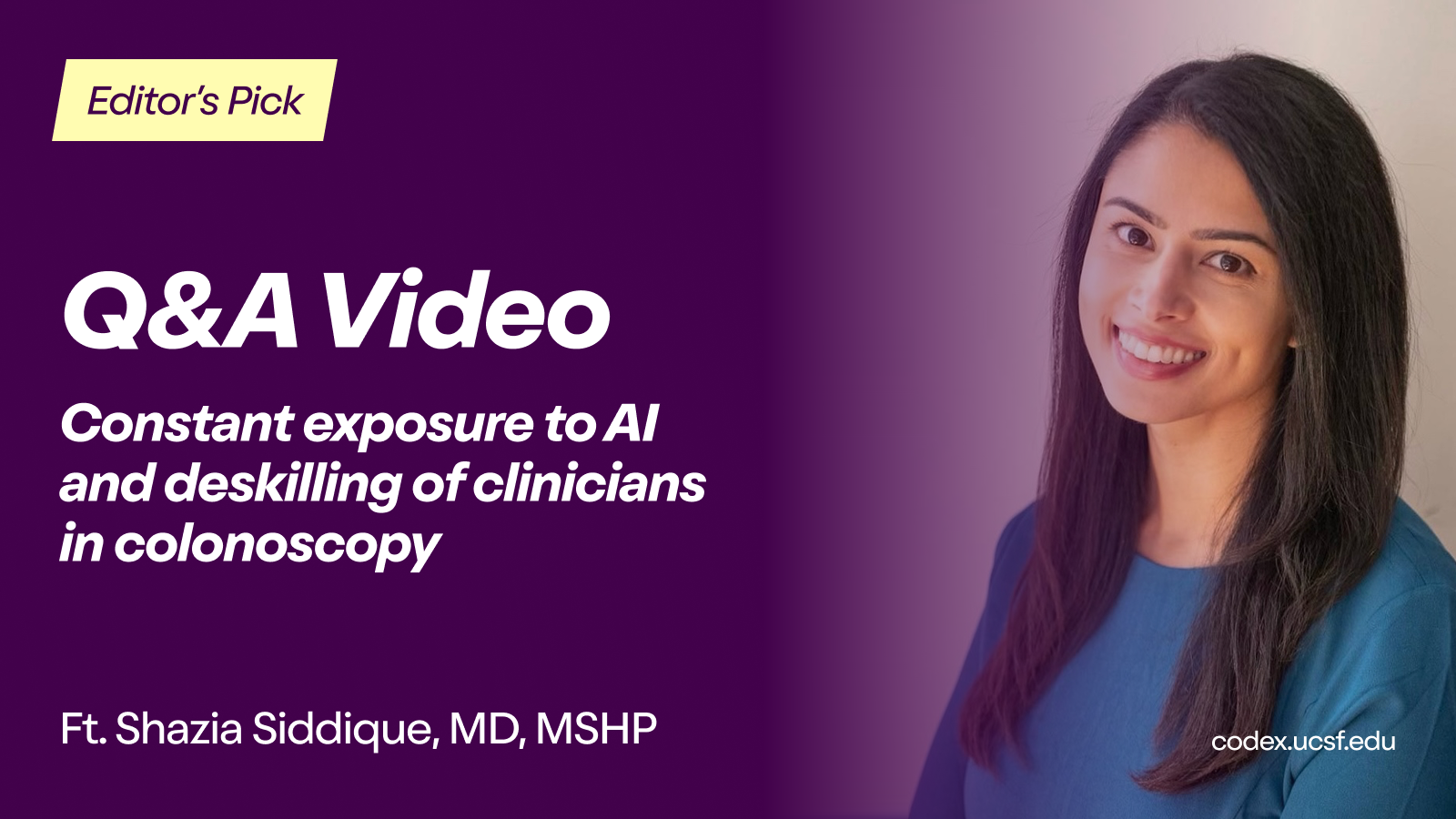
Click the image above to view the video.
Shazia Siddique, MD, MSHP
Assistant Professor of Medicine, Division of Gastroenterology
Co-Director, ECRI-Penn Evidence-based Practice Center, AHRQ
Director of Research, Center for Healthcare Improvement and Patient Safety (CHIPS)
Senior Fellow, Leonard Davis Institute for Health Economics
University of Pennsylvania
__
(Note: The responses below are highlights from the Q&A video above from Shazia Siddique.)
What's the point?
When we look at diagnostic quality during colonoscopy, we use a quality metric called adenoma detection rate, or ADR. Essentially, how many precancerous growths are identified and removed. This study showed that AI can boost ADR, or diagnostic quality, when it's on. But vigilance can slip once it's off.
The Bottom Line: There's been a lot of excitement recently about the role of AI in colonoscopy and using various metrics, but this study really found that some of our highest performers actually can slip in their diagnostic excellence after being exposed to AI.
Why does this matter?
 First, this study really shows that diagnostic resilience is at stake with the use of AI. If our top performers lose sharpness when AI is not there for whatever reason due to technological difficulties, accessibility issues, then our patients may not benefit from their skill as a result. Secondly, there is a paradox for excellence. High performers actually benefit the least from artificial intelligence, which was shown in the American Gastroenterological Association's guideline, but now we're seeing that the study suggests that they are actually at the greatest risk of de-skilling after using AI. Paradoxically, the people who started out the best in terms of diagnostic quality were the ones who slipped the most once AI was in play.
The guideline was really interesting because the draft actually came out saying that the AGA suggests in favor of the use of artificial intelligence in colonoscopy, but then, after a very heavy public comment period, that statement was revised to state that the AGA makes no recommendation. Which is a very controversial thing to do and to say. ...We are only finding these surrogate process metrics that show improvement, and we really don't know that it's improving patient outcomes, like cancer detection and death.
For every intervention that you have, like AI, there is a trade-off between benefits and harms, and we're already starting to learn about some of these harms and endoscopist de-skilling that needs to be taken into account. ...Diagnostic excellence isn't just about what we do on average, it's also about protecting our top performers from unintended harm for our patients.
Who does this impact?
For clinicians, it's really important to realize that high performers should not assume that AI is automatically going to help them. It may require us to have some time practicing doing colonoscopy and having intentional vigilance with AI off in order to preserve our expertise here.
For health system and quality health leaders, it really highlights the findings and the recommendations from the American Gastro Association guideline, which shows that AI can be promising, but it isn't necessarily ready for prime-time use, and when we deploy it, we have to think carefully about education and trade-offs.
For researchers, it would be great for us to also think about studying this prospectively, to better understand how clinicians are impacted in a real-world setting.
For patients, the one reassurance here is that cancer detection rates didn't actually fall as a result of this, and this is because cancer and large polyps tend to be a lot more obvious to find compared to the smaller polyps, or precancerous growths. Although this is an important early finding, it actually doesn't yet show that this would definitely impact patient outcomes like death.
__
Share your thoughts and join the conversation on LinkedIn.
About Editor's Picks
Curated by the UCSF CODEX team, each Editor’s Pick features a standout study or article that moves the conversation on diagnostic excellence forward. These pieces offer meaningful, patient-centered insights, use innovative approaches, and speak to the needs of patients, clinicians, researchers, and decision-makers alike. All are selected from respected journals or outlets for their rigor and real-world relevance.
View more Editor's Picks here.