
Editor's Pick: Care Team Model and Diagnostic Error Risk
Care Team Model and Diagnostic Error Risk in Medical Patients Who Transferred to the ICU or Died
Knees M, Hubbard C, Burden M, Raffel K, Schnipper J, Auerbach A. Care Team Model and Diagnostic Error Risk in Medical Patients Who Transferred to the ICU or Died. J Gen Intern Med. Published online January 26, 2026. doi:10.1007/s11606-026-10224-w
Journal of General Internal Medicine
January 26, 2026
__
Q&A Video Michelle Knees, DO
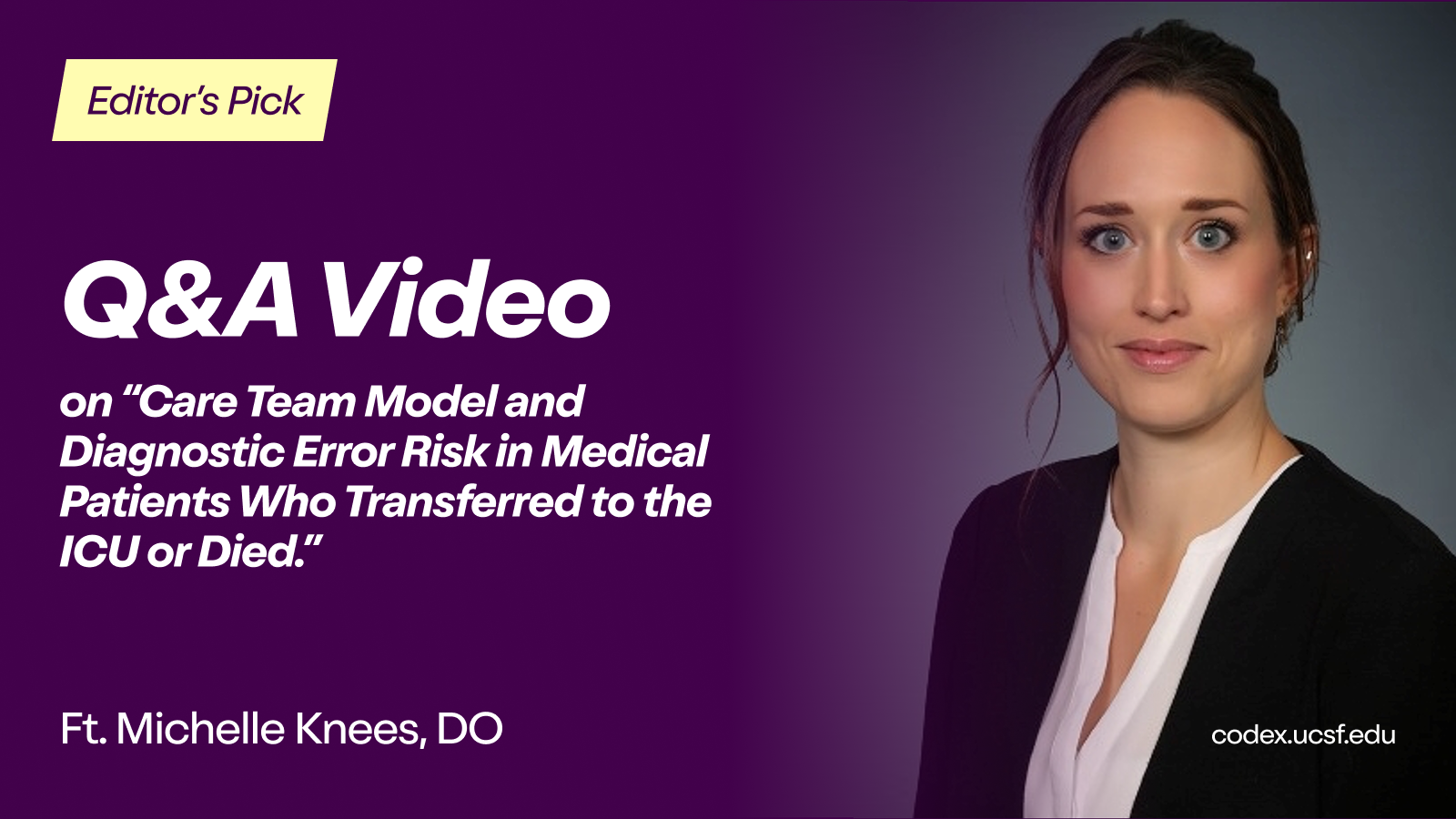
Watch the full Q&A here.
Michelle Knees, DO
Assistant Professor, Division of Hospital Medicine,
University of Colorado Anschutz School of Medicine
__
(Note: The responses below are highlights from the Q&A video above from Dr. Knees.)
What's the point?
The point of this study was to investigate whether care team models impact the risk of diagnostic errors among medical inpatients who transfer to the ICU or die during their admission. To investigate this, we used an existing data set from the UPSIDE trial and looked at whether the type of care team responsible for a hospitalized patient was associated with different rates of diagnostic errors.
More specifically, we compared three different care team models. The first was a solo attending physician working alone, the second was teams where there were residents working alongside an attending physician, and then the third was care team models that included an advanced practice clinician, like an NP or a PA, who was often but not always working with an attending physician.
Before talking about the results, I do want to note that this study was exploratory. It should only be taken as hypothesis generating, but we did ultimately find that CARE 2 models may impact diagnostic error risk, even after adjusting for multiple factors. More specifically, we found that solo attending care was associated with a higher risk of any diagnostic error that’s both harmful and not harmful compared to teaching teams. And then we also saw a trend towards a higher risk of harmful diagnostic errors for direct care compared with APP teams, but this did not meet statistical significance.
Why does this matter?
I think this study matters because it suggests that the care team model may be an important risk factor, or a modifier for diagnostic errors, and these are a leading patient safety concern.
We have two hypotheses for what may have contributed to these results that are worth exploring further. The first is that having multiple clinicians involved in the diagnostic process, like, occurs when a resident and attending reason for a case together, may create a naturally more robust diagnostic reasoning process. Our second hypothesis involves workload. On average, we know that solo attending physicians carry more patients than resident or APP teams, and we also know that higher workload and the associated higher cognitive load can negatively impact diagnostic reasoning.
So, better understanding both of these factors and how they may contribute to the clinical reasoning environment is really important for designing safer systems.
Who does this impact?
For health systems and administrators, it may be a signal that staffing model decisions do have patient safety implications, which I think we all sense, but this is some of data that supports that.
For researchers, I think this opens up questions about what specific features of patient care may improve diagnostic performance, getting more into that collective intelligence and workload aspect.
But more broadly, I think as patient volume and complexity increases, and as systems begin to make decisions around how to best use physicians, APPs, and residents, it's increasingly important to design safer systems that support both patients and the providers taking care of them.
I think we really need to consider how team-based structures, cognitive load, and workload influence our diagnostic processes, and work more broadly to identify opportunities for diagnostic improvement throughout all of our healthcare systems.
__
Share your thoughts and join the conversation on LinkedIn.
About Editor's Picks
Curated by the UCSF CODEX team, each Editor’s Pick features a standout study or article that moves the conversation on diagnostic excellence forward. These pieces offer meaningful, patient-centered insights, use innovative approaches, and speak to the needs of patients, clinicians, researchers, and decision-makers alike. All are selected from respected journals or outlets for their rigor and real-world relevance.
View more Editor's Picks here.