
Editor's Pick: Diagnostic Timing and Ovarian Cancer Survival
Diagnostic Timing and Ovarian Cancer Survival
Soppe SE, Kuo TM, Bae-Jump VL, et al. Diagnostic Timing and Ovarian Cancer Survival. JAMA Netw Open. 2026;9(3):e262434. Published 2026 Mar 2. doi:10.1001/jamanetworkopen.2026.2434
JAMA Network Open
March 2, 2026
__
Q&A Video ft. Sarah Soppe, MPH
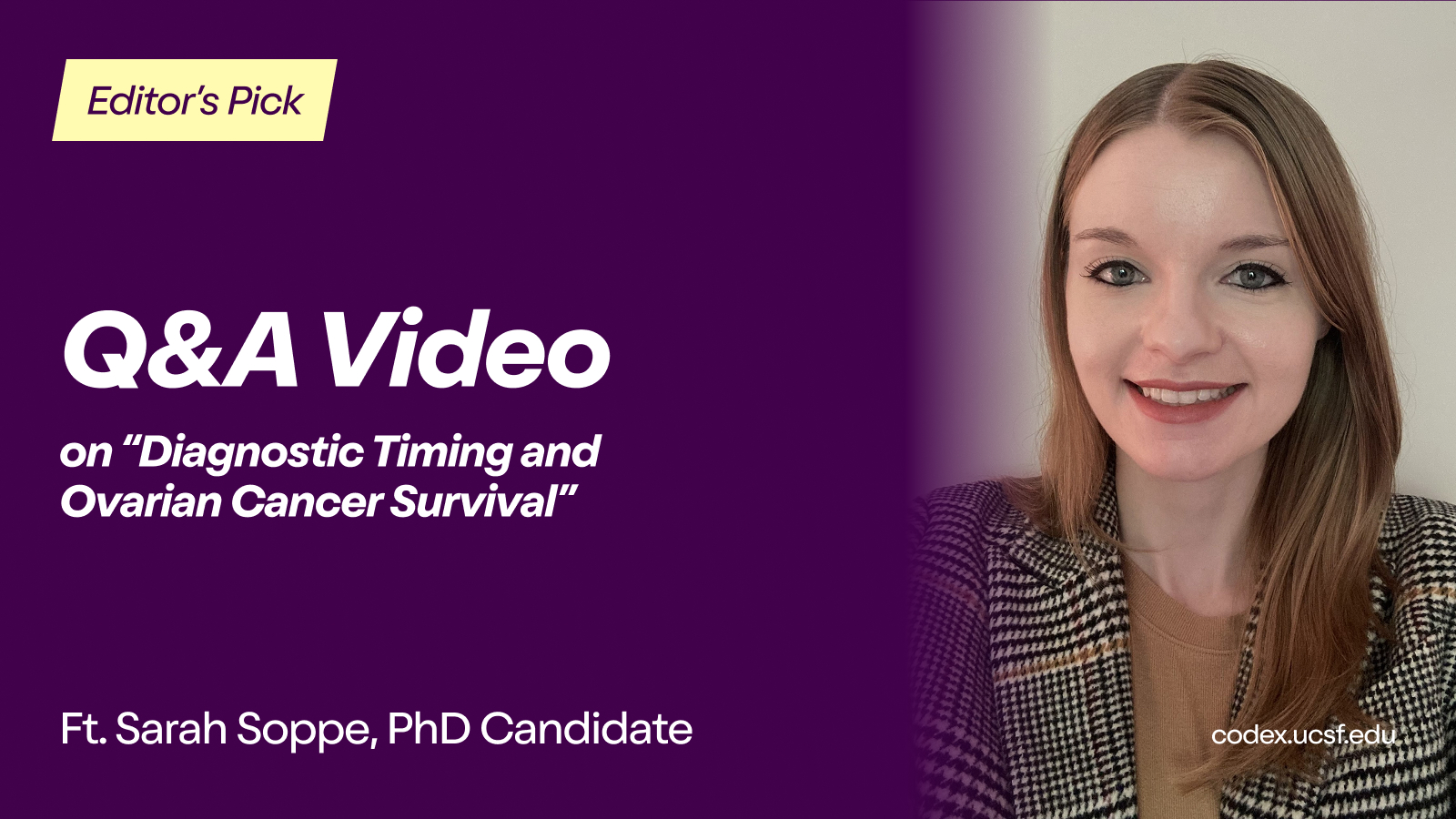
Watch the full Q&A here.
Sarah Soppe, MPH
PhD Candidate, University of North Carolina
__
(Note: The responses below are highlights from the Q&A video above from Sara Soppe, MPH.)
What's the point?
Ovarian cancer is notoriously difficult to diagnose. Most patients only present with symptoms that are common in the general population, like abdominal pain and gastrointestinal issues. And most patients who present with these types of symptoms are unlikely to have ovarian cancer, and this makes it difficult for clinicians to determine when to suspect ovarian cancer rather than a more common condition. We know that earlier diagnosis improves outcomes for many cancer sites by detecting cancer at a more treatable stage.
However, this has not been clear for ovarian cancer. Several studies have suggested that faster diagnosis does not actually improve patient outcomes in ovarian cancer, discouraging investment in diagnostic improvements.
One possible explanation for these findings could be that sicker patients are easier to diagnose faster, as they have clearer signs and symptoms of ovarian cancer. This could cause faster diagnosis to appear associated with poorer survival, and potentially mask any negative impact of diagnostic delay. This concept is called the wait-time paradox in the epidemiology literature, and it poses a bias that makes it difficult to estimate the true impact of diagnostic delays on patient outcomes.
The goal of our study was to use a flexible modeling approach to evaluate whether the wait time paradox may be influencing our conclusions around whether diagnostic timeliness matters. We used the UNC Cancer Information and Population Health Resource, which includes data on over 2,300 patients with ovarian cancer in North Carolina. We estimated the time between when the patient first presented to the healthcare system with symptoms and their ultimate cancer diagnosis.
We found results consistent with the wait-time paradox, where patients with the fastest diagnosis had the poorest survival. These patients were more likely to present with abdominal swelling consistent with advanced disease. However, we also found that patients with the longest time to diagnosis also had poorer survival relative to those with an intermediate time to diagnosis. These patients were also likely to be diagnosed at an advanced stage, but they had less clear initial symptoms, leading to more doctor visits and likely more cancer progression before cancer diagnosis and treatment.
The bottom line: This U-shaped pattern between cancer mortality and the time to diagnosis suggests that diagnostic delays may matter for ovarian cancer outcomes, which was only visible when we used a flexible modeling approach. When we used a traditional linear model, as in most prior studies, time to diagnosis did not appear to have any impact.
Why does this matter?
These results suggest that the prior evidence that diagnostic timeliness does not matter for ovarian cancer may have been related to methodological limitation rather than the true biological reality. It may be possible that earlier identification of ovarian cancer could lead to earlier stage at diagnosis and better treatment outcomes for some patients.
Who does this impact?
Our hope is that these findings will encourage health systems and researchers to invest in clinical tools to help primary care clinicians navigate nonspecific ovarian cancer symptoms. Development of predictive models and other clinical strategies could help identify the rare ovarian cancer patient earlier out of the many women who present with abdominal pain or gastrointestinal complaints. We also hope that this study will highlight the issue of the wait-time paradox, and encourage researchers to identify other scenarios where the importance of diagnostic timeliness has been underestimated due to this type of bias.
What's next?
My ultimate goal as a diagnostic researcher is to improve outcomes for patients with vague symptoms who may have a long journey in the healthcare system before they receive any medical answers. I believe that we can use administrative healthcare data to help make the diagnostic process easier for these patients by carefully considering the best approach to analyzing the data. The study was one example where methodological choices may influence our clinical understanding. Following this study, I am working on developing evidence to help clinicians navigate non-specific ovarian cancer symptoms as the focus of my dissertation project here at the University of North Carolina.
__
Share your thoughts and join the conversation on LinkedIn.
About Editor's Picks
Curated by the UCSF CODEX team, each Editor’s Pick features a standout study or article that moves the conversation on diagnostic excellence forward. These pieces offer meaningful, patient-centered insights, use innovative approaches, and speak to the needs of patients, clinicians, researchers, and decision-makers alike. All are selected from respected journals or outlets for their rigor and real-world relevance.
View more Editor's Picks here.